
Metric vs. Imperial vs. US units, for measuring
Metric vs. Imperial. Round 1… Fight! 🥊
In this post, I will share my (very) biased opinion on how I feel about the metric, imperial, and US systems for measurement.
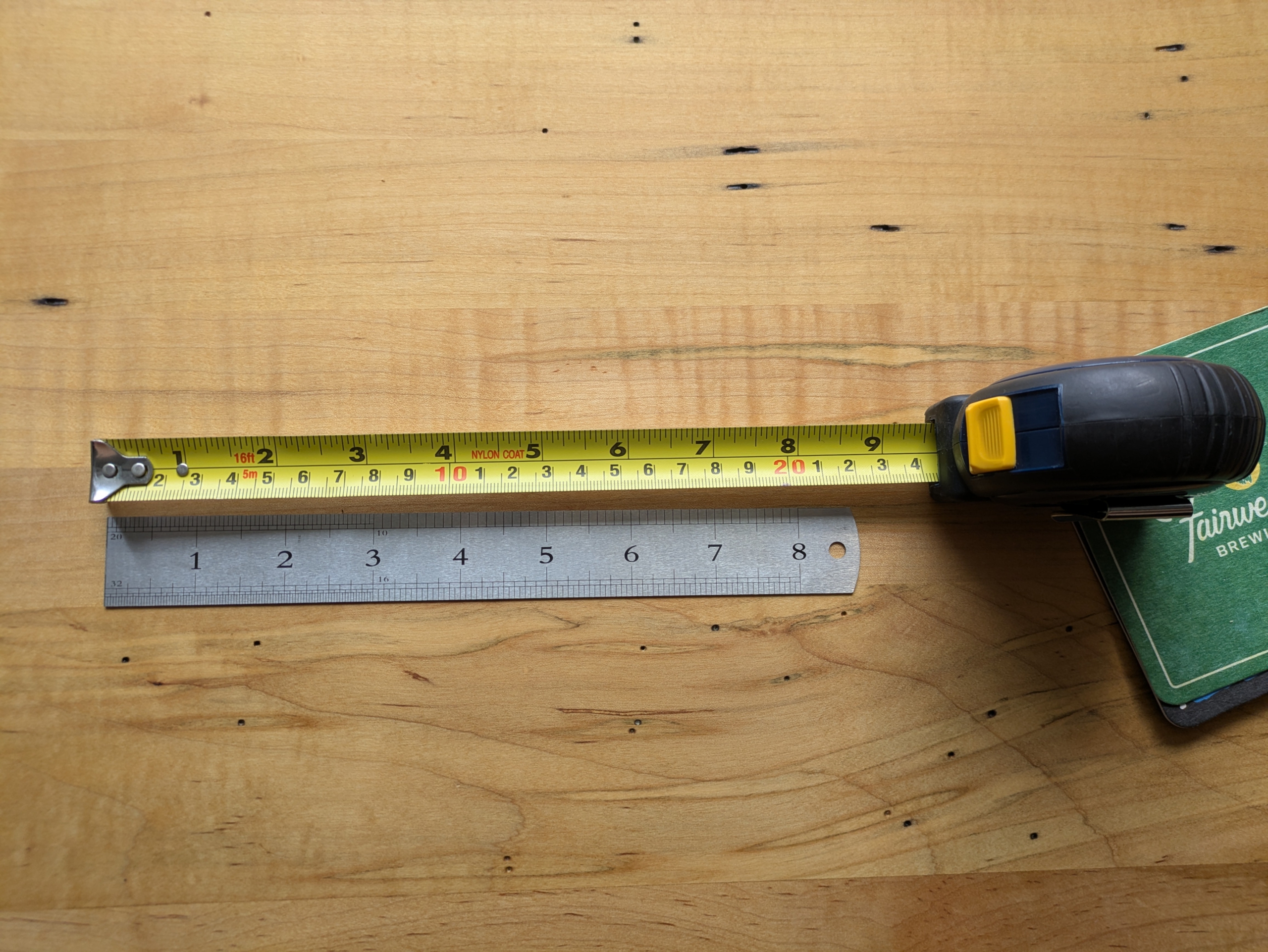
Measuring tape with both metric and imperial, and a metal ruler in imperial. Measuring tape shimmed with beer coasters so it isn't pointing up in the air.
Published July 17, 2026
Metric system enjoyer
As a Canadian, I am an enjoyer of the metric system. Unfortunately, as America’s closest neighbour, we are strongly influenced to use the imperial system. In this post rant, I’m going to go over some of the things that I enjoy about the metric system, as well as some of the confusion that I’ve experienced using the imperial system and the US system for measuring things. In Canada, we are all too familiar with a mix of different units for measuring things:
- Measuring tapes and rulers are in both inches and centimetres, so depending on who’s taking the measurements and what system they prefer, measurements could be taken in imperial or metric
- When shopping at the grocery store, prices are shown in price per pound but ring up at the cash register in price per kilogram
- When shopping for a cooler online (for keeping food and drinks cold while traveling), the sizes are shown in how much volume they hold, which uses both litres and quarts… Yes, quarts! What even is a quart? It’s 1.0566882094 litres, actually… or is it 1.18294 litres… or maybe 0.946353 litres…
I really like the simplicity of the metric system. With a base of 10, it’s very easy to work with in the 2D world for measuring length:
- 1 centimetre (cm) is 10 millimetres (mm)
- 1 metre (m) is 100 centimetres
- 1 kilometre (km) is 1000 metres
- And less commonly, 1 decimetre is 10 centimetres
And in the 3D world for measuring volume:
- 1 millilitre (mL) is the smallest unit
- 1 centilitre (cL) is 10 millilitres
- 1 decilitre (dL) is 10 centilitres or 100 millilitres
- 1 litre (L) is 1000 millilitres
Everything just makes sense. It’s simple because it’s all in multiples of 10.
A ruler that uses the metric system is easy to use. Centimetres are fairly small, and each of the 10 millimetres in a centimetre has its own line, with the 5th millimetre line being slightly longer to denote 5 millimetres (or half a centimetre).

A ruler showing 10 centimetres, with a line displayed at each millimetre. The 5 millimetre line is slightly longer.
The imperial system is unnecessarily complex
Hot take, but the imperial system for measuring is unnecessarily complex. Compared to the metric ruler above, here’s an imperial one.

Ruler that uses the imperial system, showing inches. There are lines every 1/16th of an inch.
Base-16 instead of base-10

“All your base are belong to us” (Zero Wing, a Japanese video game)
While the metric system uses a base of 10, tape measures that use inches use a base of 16, dividing each inch into 16 parts. One inch is divided by 16 and each of these lines is displayed on the ruler as $\frac{1}{16}$”.
To make things even more complicated, because it’s using fractions, and you can’t just say $\frac{1}{16}, \, \frac{2}{16}, \, \frac{3}{16}, \, \frac{4}{16}$ all the way up to $\frac{16}{16}$, you have to reduce the fraction to the lowest possible denominator. This means that $\frac{8}{16}$ would turn into $\frac{1}{2}$.
To reduce a fraction, you need to divide the numerator (the top part) and the denominator (the bottom part) by their greatest common factor. In the case of $\frac{8}{16}$, their greatest common factor is 8 since 8 can go into 16. 8 goes into 16 twice (so 2) and 8 goes into 8 once (so 1), therefore the result is $\frac{1}{2}$.
$$\frac{8 \div 8}{16 \div 8} = \frac{1}{2}$$
A colourful example
In programming, especially front-end development, we use base-16 sometimes, like for colours. In a base-10 number system, like metric, you count from 0 to 10, e.g. 0, 1, 2, 3, 4, 5, 6, 7, 8, 9, 10. In a base-16 number system, like when working with colours in hexadecimal format, you count from 0 to F. 0 to F, you say? Yes. Like this: 0, 1, 2, 3, 4, 5, 6, 7, 8, 9, 10, A, B, C, D, E, F. Easy, right? Colours are represented in hexadecimal using the RGB system, which means a system that uses red, green and blue levels. Here are some examples:
- Red is
#FF0000 - Green is
#00FF00 - Blue is
#0000FF
To make things even more complicated, you can have an alpha value, which is a percentage value of 0% to 100% represented in base-16. Here’s an example:
- Pink at 100% alpha is
#FF00EAFF - Pink at 99% alpha is
#FF00EAFC - Pink at 98% alpha is
#FF00EAFA - Pink at 97% alpha is
#FF00EAF7 - Pink at 96% alpha is
#FF00EAF5 - Pink at 95% alpha is
#FF00EAF2 - Pink at 94% alpha is
#FF00EAF0 - Pink at 93% alpha is
#FF00EAED - Pink at 92% alpha is
#FF00EAEB - Pink at 91% alpha is
#FF00EAE8 - Pink at 90% alpha is
#FF00EAE6 - Pink at 89% alpha is
#FF00EAE3 - Pink at 88% alpha is
#FF00EAE0 - Pink at 87% alpha is
#FF00EADE - Pink at 86% alpha is
#FF00EADB - Pink at 85% alpha is
#FF00EAD9 - Pink at 84% alpha is
#FF00EAD6 - Pink at 83% alpha is
#FF00EAD4 - Pink at 82% alpha is
#FF00EAD1 - Pink at 81% alpha is
#FF00EACF - Pink at 80% alpha is
#FF00EACC - Pink at 79% alpha is
#FF00EACA - Pink at 78% alpha is
#FF00EAC7 - Pink at 77% alpha is
#FF00EAC4 - Pink at 76% alpha is
#FF00EAC2 - Pink at 75% alpha is
#FF00EABF - Pink at 74% alpha is
#FF00EABD - Pink at 73% alpha is
#FF00EABB - Pink at 72% alpha is
#FF00EAB8 - Pink at 71% alpha is
#FF00EAB5 - Pink at 70% alpha is
#FF00EAB3 - Pink at 69% alpha is
#FF00EAB0 - Pink at 68% alpha is
#FF00EAAD - Pink at 67% alpha is
#FF00EAAB - Pink at 66% alpha is
#FF00EAA8 - Pink at 65% alpha is
#FF00EAA6 - Pink at 64% alpha is
#FF00EAA3 - Pink at 63% alpha is
#FF00EAA0 - Pink at 62% alpha is
#FF00EA9E - Pink at 61% alpha is
#FF00EA9B - Pink at 60% alpha is
#FF00EA99 - Pink at 59% alpha is
#FF00EA96 - Pink at 58% alpha is
#FF00EA94 - Pink at 57% alpha is
#FF00EA91 - Pink at 56% alpha is
#FF00EA8E - Pink at 55% alpha is
#FF00EA8C - Pink at 54% alpha is
#FF00EA89 - Pink at 53% alpha is
#FF00EA87 - Pink at 52% alpha is
#FF00EA84 - Pink at 51% alpha is
#FF00EA82 - Pink at 50% alpha is
#FF00EA80 - Pink at 49% alpha is
#FF00EA7D - Pink at 48% alpha is
#FF00EA7A - Pink at 47% alpha is
#FF00EA78 - Pink at 46% alpha is
#FF00EA75 - Pink at 45% alpha is
#FF00EA73 - Pink at 44% alpha is
#FF00EA70 - Pink at 43% alpha is
#FF00EA6E - Pink at 42% alpha is
#FF00EA6B - Pink at 41% alpha is
#FF00EA69 - Pink at 40% alpha is
#FF00EA66 - Pink at 39% alpha is
#FF00EA63 - Pink at 38% alpha is
#FF00EA61 - Pink at 37% alpha is
#FF00EA5E - Pink at 36% alpha is
#FF00EA5C - Pink at 35% alpha is
#FF00EA59 - Pink at 34% alpha is
#FF00EA57 - Pink at 33% alpha is
#FF00EA54 - Pink at 32% alpha is
#FF00EA52 - Pink at 31% alpha is
#FF00EA4F - Pink at 30% alpha is
#FF00EA4D - Pink at 29% alpha is
#FF00EA4A - Pink at 28% alpha is
#FF00EA47 - Pink at 27% alpha is
#FF00EA45 - Pink at 26% alpha is
#FF00EA42 - Pink at 25% alpha is
#FF00EA40 - Pink at 24% alpha is
#FF00EA3D - Pink at 23% alpha is
#FF00EA3B - Pink at 22% alpha is
#FF00EA38 - Pink at 21% alpha is
#FF00EA36 - Pink at 20% alpha is
#FF00EA33 - Pink at 19% alpha is
#FF00EA30 - Pink at 18% alpha is
#FF00EA2E - Pink at 17% alpha is
#FF00EA2B - Pink at 16% alpha is
#FF00EA29 - Pink at 15% alpha is
#FF00EA26 - Pink at 14% alpha is
#FF00EA24 - Pink at 13% alpha is
#FF00EA21 - Pink at 12% alpha is
#FF00EA1F - Pink at 11% alpha is
#FF00EA1C - Pink at 10% alpha is
#FF00EA1A - Pink at 9% alpha is
#FF00EA17 - Pink at 8% alpha is
#FF00EA14 - Pink at 7% alpha is
#FF00EA12 - Pink at 6% alpha is
#FF00EA0F - Pink at 5% alpha is
#FF00EA0D - Pink at 4% alpha is
#FF00EA0A - Pink at 3% alpha is
#FF00EA08 - Pink at 2% alpha is
#FF00EA05 - Pink at 1% alpha is
#FF00EA03 - Pink at 0% alpha is
#FF00EA00
Isn’t that fun? Now memorize that. I can’t memorize it, that’s why I’m putting every value between 0-100%, and it’s not only to illustrate how confusing thinking about $\frac{1}{16}$ of a thing is, but because I’ll need to inevitably refer to this when I’m working on a web project.
Base-16, for me at least, has never been fun to work with. I have never been able to memorize percentages represented in base-16. The exact same colour system can be represented using base-10 for the alpha channel (but a base of 255 for each colour, just ignore that part). This will be a lot smaller since it’s pretty clear what the patterns are (0 through 1.0):
- Pink at 100% alpha is
rgba(255, 0, 234, 1.0) - Pink at 95% alpha is
rgba(255, 0, 234, 0.95) - Pink at 90% alpha is
rgba(255, 0, 234, 0.9) - Pink at 50% alpha is
rgba(255, 0, 234, 0.5) - Pink at 40% alpha is
rgba(255, 0, 234, 0.4) - Pink at 30% alpha is
rgba(255, 0, 234, 0.3) - Pink at 20% alpha is
rgba(255, 0, 234, 0.2) - Pink at 15% alpha is
rgba(255, 0, 234, 0.15) - Pink at 10% alpha is
rgba(255, 0, 234, 0.1) - Pink at 9% alpha is
rgba(255, 0, 234, 0.09) - Pink at 8% alpha is
rgba(255, 0, 234, 0.08) - Pink at 7% alpha is
rgba(255, 0, 234, 0.07) - Pink at 6% alpha is
rgba(255, 0, 234, 0.06) - Pink at 5% alpha is
rgba(255, 0, 234, 0.05) - Pink at 4% alpha is
rgba(255, 0, 234, 0.04) - Pink at 3% alpha is
rgba(255, 0, 234, 0.03) - Pink at 2% alpha is
rgba(255, 0, 234, 0.02) - Pink at 1% alpha is
rgba(255, 0, 234, 0.01) - Pink at 0% alpha is
rgba(255, 0, 234, 0.0)
When we talk about about colours, it’s illustrated pretty simply that a base-10 system is much simpler than a base-16 system, at least in our number system.
Other units of measurement in the 3D world
To add even more complexity, while the US uses the imperial system in the 2D world, it has its own system in the 3D world, which uses the same names as imperial units! This is confusing.
The base unit, a fluid ounce, differs between imperial and the US systems. Here’s a quote from Wikipedia:
An imperial fluid ounce is $\frac{1}{20}$ of an imperial pint, $\frac{1}{160}$ of an imperial gallon, or exactly 28.4130625 mL.
A US customary fluid ounce is $\frac{1}{16}$ of a US liquid pint, $\frac{1}{128}$ of a US gallon, or exactly 29.5735295625 mL, making it about 4.084% larger than the imperial fluid ounce.
A US food labeling fluid ounce is exactly 30 mL.
In the imperial system, which uses imperial fluid ounces:
- 1 fluid ounce (fl. oz.) is equivalent to 28.41 mL
- 1 cup is 10 fl. oz.
- 1 pint is 20 fl. oz.
- 1 quart is 2 pints (40 fl. oz.)
- 1 gallon is 4 quarts (160 fl. oz.)
In the US system, which uses US customary fluid ounces (or is it food labeling fluid ounces?):
- 1 cup is 8 fluid ounces
- 1 pint is 2 cups (16 fl. oz.)
- 1 quart is 2 pints (32 fl. oz.)
- 1 gallon is 4 quarts (128 fl. oz.)
The base unit “fluid ounce” is ambiguous, depending on where you are in the world, and in the US, also depending on the context.
🤯 I’m confused. That’s a lot of unnecessary math. If only there was an easier way…
The international inch
The international inch is 2.54 centimetres. Wikipedia also has a fun interactive conversion table.
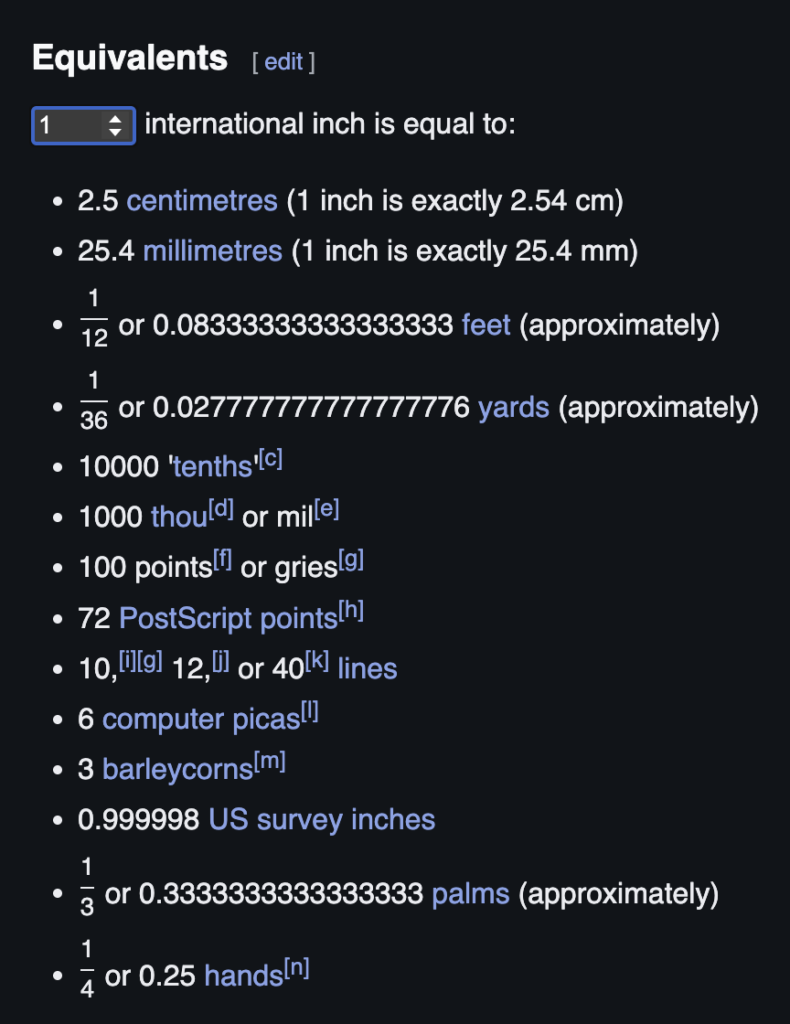
Wikipedia inch equivalents
It’s equivalent to:
- $\frac{1}{36}$ of a yard
- $\frac{1}{12}$ of a foot
In another part of the world, China has a unit called a cun, which is often translated into English as the “Chinese inch.” My computer’s spell check is showing me a red underline to let me know “cun” is not a word in English. I’m not even sure how to pronounce it without getting side-eyed. The width of 4 fingers side-by-side is 3 cuns. 1 cun translated to metric is $\frac{1}{30}\text{ m}$, so roughly 33.3333 millimetres, and converted to imperial and US inches is approximately 1.3123 inches. Here‘s a funny clip that references Chinese inches.
Solutions to fractional inches
There are several solutions to fractional inches. The most obvious one, for me anyhow, is to abandon the imperial system and switch to the metric system. Given that this is the way we’ve been doing construction since the 19th century, I doubt we’re planning on changing it anytime soon. Instead, companies have been building solutions for working with this convoluted system.
Printed fractional units
Some companies, like Milwaukee, have designed tape measures that show the fractional units printed on them, which I think is kinda cool. It means we don’t have to remember that the 6th line in is $\frac{3}{8}$ of an inch.
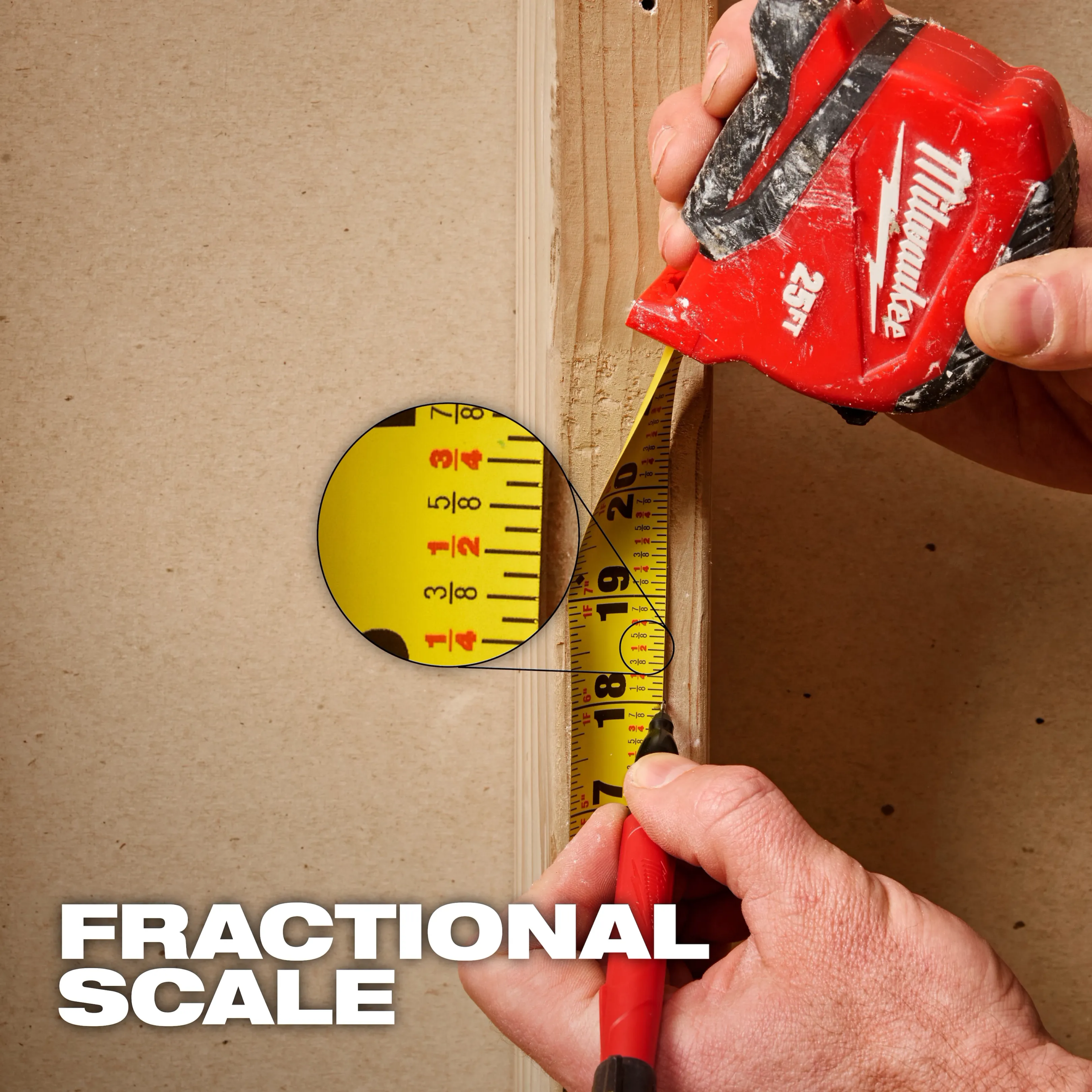
Fractional scale on a Milwaukee tape measure
This would definitely save time writing down measurements as you no longer have to count the lines and try to remember which 16th it corresponds to, and then doing the math to reduce the fraction.
Digital measuring tools
Another solution to this problem is to use digital measuring tools. Some examples:
- Digital calipers: This tool is ideal for measuring smaller items
- Laser measure: This tool is ideal for calculating the measurements between 2 solid areas, like the walls of a room, which can be useful when you need to calculate square footage to know how much flooring materials you need to purchase if you’re replacing floors
- Construction calculators: There are mobile apps and calculators that allow you to calculate various units with each other without having to perform manual conversions.
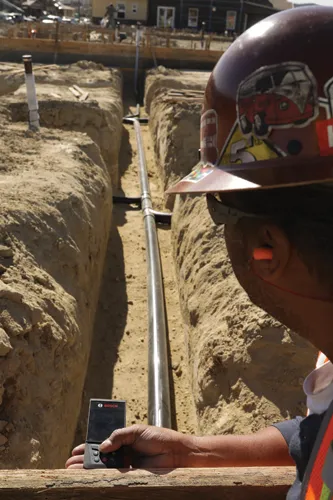
A laser measure used outdoors on a plumbing job
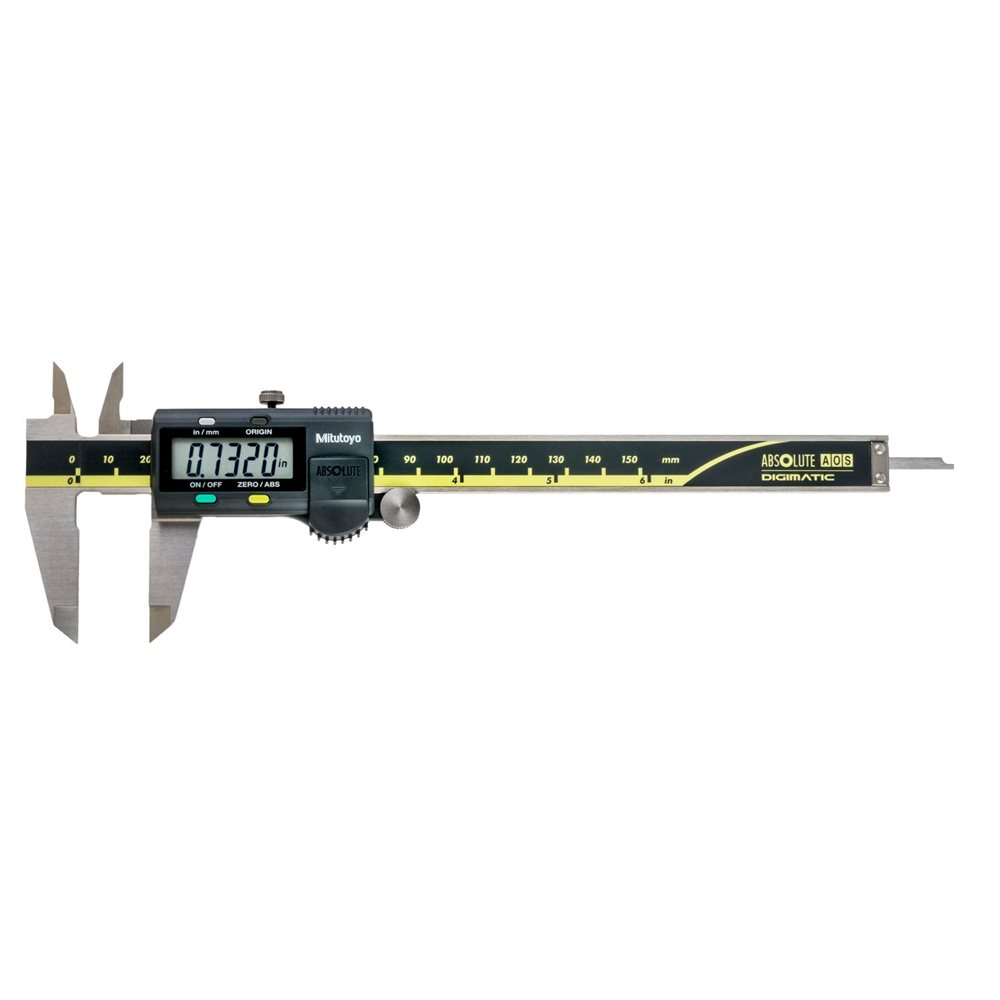
Digital calipers displaying a measurement using a floating point value for an inch (0.7320 inch)
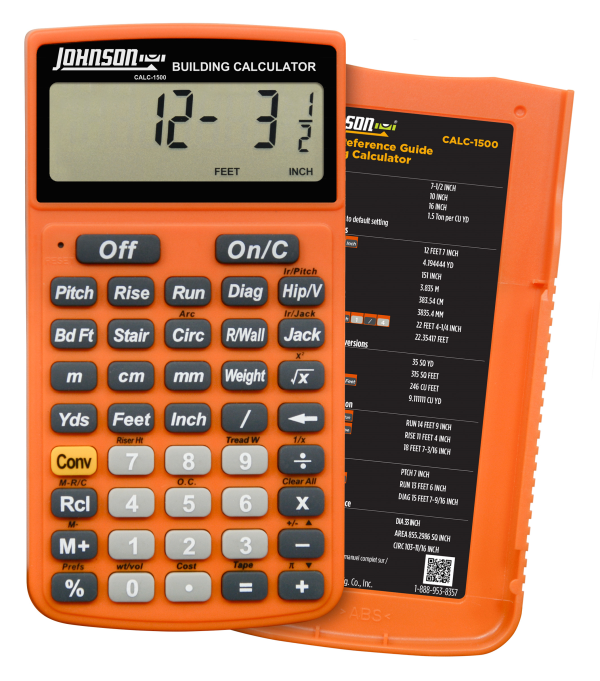
Construction calculator
There’s probably other options I’m not thinking of, but those are a few ideas that come to mind.
In conclusion
So while I love the metric system, it looks like technology has evolved to help us work within this complex imperial/US units world.