

In this post, I’m going to go through what I’ve learned about my electrical panel. In some cases, you may not have access to your electrical panel, for example, if you rent in a shared building and the panel is in an area of the building you don’t have access to. If you have access to your electrical panel, it might be fun to take a look and understand it more.
This isn’t going to be a full breakdown of the panel since I won’t be opening up the back of it to check out the wiring or other components for the sake of this article, I’m just going to discuss the parts that homeowners and renters may need to concern themselves with.
The panel door
This might seem a little silly to cover, but if you’ve never touched an electrical panel, this might be helpful. In my experience, I’ve seen panels that are grey or white in colour. There might be other colours, but these are what I’m familiar with. They’re made of metal and are painted.
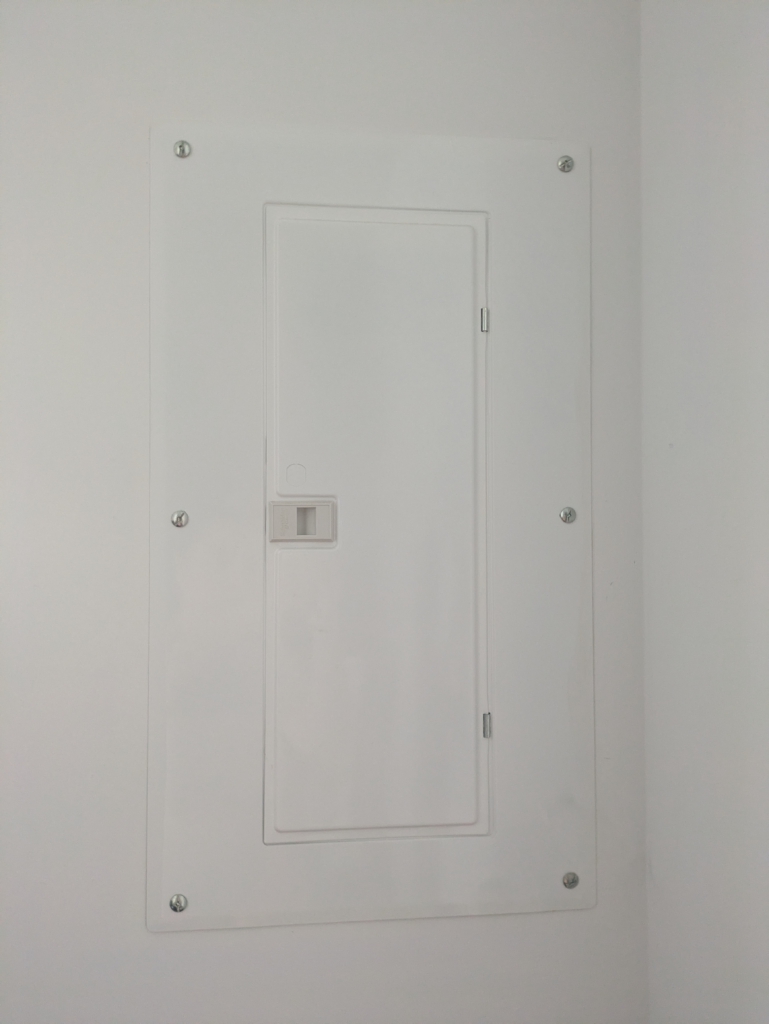
My electrical panel door
My panel is by Schneider Electric. To open it, you move the latch towards the outside, which, in my case, is to the left.
Understanding the panel
The electrical panel has a lot of components, many of which are hidden further in the panel. The main areas we need to concern ourselves with are:
- The circuit breakers (or fuses, if your panel is very old)
- The legend
There’s other stuff hidden behind the internal cover, like the actual wire connections, but I won’t be going that deep.
Circuit breakers
Circuit breakers are devices that are designed to prevent an electrical circuit from being overloaded with electricity. These safety devices are designed to protect us from electrical fires. Circuit breakers can trip in the following conditions:
- Overload condition: When a circuit has too much load (most common). A circuit is considered overloaded when the draw of power exceeds the amperage rating of the circuit breaker.
- Short-circuit condition: If there is a short circuit, which is when electrical current travels along an unintended path, which causes a sudden surge in power to the circuit. This can happen when an unexpected wire (or another unexpected conductor) gets into contact with a wire.
Circuit breakers are available in various amperage ratings (more on that later).
Diving deeper into circuit breakers
I wanted to dig a bit deeper and I found this video, which is an excellent resource about the internals of a circuit breaker.
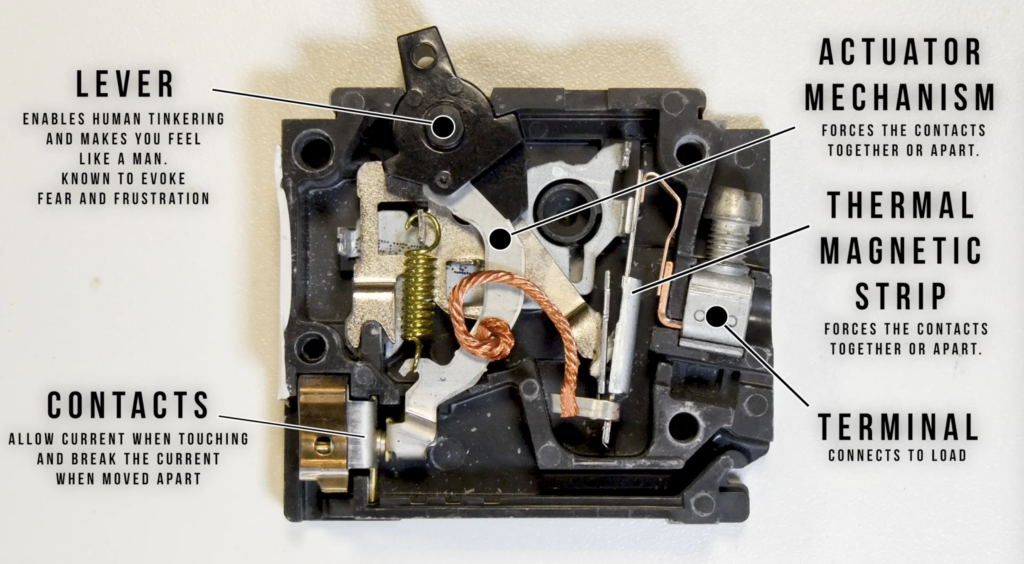
Anatomy of a circuit breaker
In an overload condition, the excessive draw of power creates heat beyond a specific threshold, which causes the metals inside to change shape, which forces the contacts apart. This separation of the electrical contacts prevent electricity from traveling through the circuit.
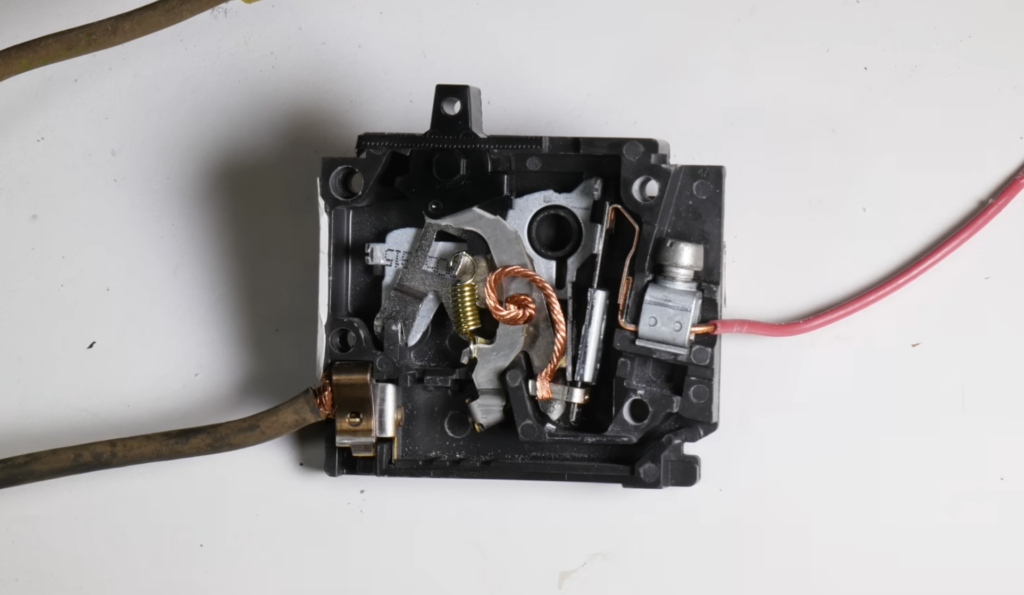
Circuit breaker in the tripped state
When the breaker is tripped due to an overload condition, thermal-sensitive parts of the device are heated up due to the heat caused by the excessive amperage. This causes the thermal parts of the mechanism to engage, which forces the contacts to separate and the lever to be flipped to the tripped position.
When the breaker is tripped due to a short circuit condition, rather than a gradual increase in heat, the magnetic parts of the mechanism engage to interrupt the flow of power.
Most common household type seems to be thermal-magnetic. What that means is they’ve combined two mechanisms in one: a thermal overload for gradual over-current situations; and a magnetic device in situations that need to be interrupted immediately.Warped
Fuses
In older homes, before circuit breakers were used, fuses inside of fuse boxes were common. Unlike breakers that have internal mechanisms that engage in specific conditions, and can be reset, fuses are one-time use items that are consumed as soon as the fuse is blown.
I remember when I was very young, my family would be cooking, which would occasionally blow a fuse. My dad had to go out and buy new fuses to restore power to the stove.
Fuses are very similar to lightbulbs in that they are made of glass, contain a filament, and screw into the fuse box. Fuses protect you in an overload condition. The filament inside of the fuse is designed to break when it gets too hot. Just like a lightbulb, when the fuse goes out, you need to replace it with a new one because that filament inside is broken, which breaks the flow of current in the circuit.
Just like circuit breakers, fuses are available in various amperages too.
There are also canister-shaped fuses, too.
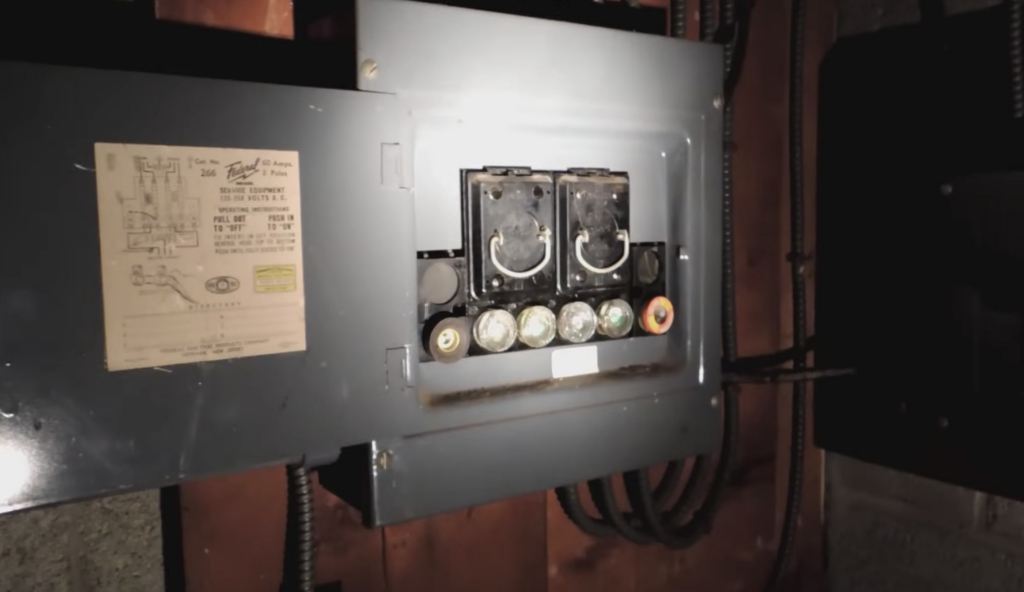
Fuse box with fuses in an older home
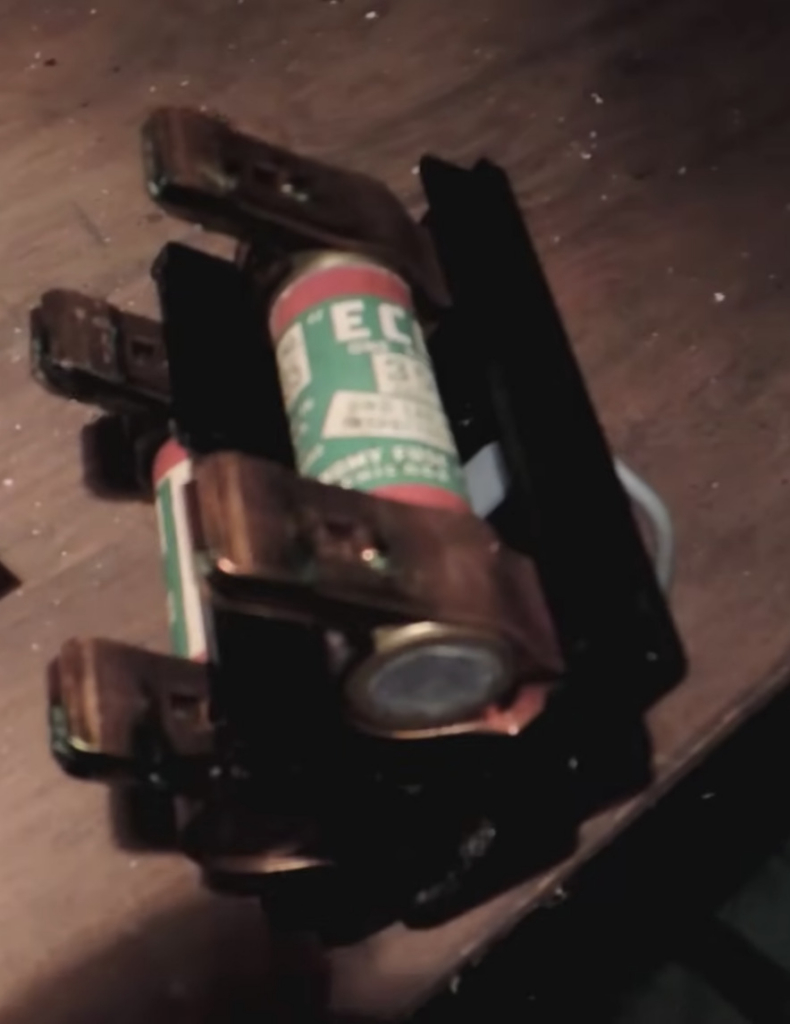
Canister fuse from a fuse box in an older home
I watched this video to learn more about fuses and fuse boxes found in homes.
Fuses are also commonly used in D/C electrical systems like in cars and battery-powered electronics, though these look much different and are significantly smaller than the ones in homes.
Circuit breaker amperage
Commonly, 15-amp breakers are used for receptacles and lighting, and in modern homes, 20-amp breakers are used for receptacles in the kitchen, and sometimes bathroom, where there is more of a demand for appliances that draw more power than usual, like electric kettles, toasters, toaster ovens, air fryers, microwaves, and hair dryers.
Below are some pictures of my panel, which includes the circuit breakers and the legend. From reading the legend and looking at the circuit breakers, I learned the following:
- Most of my electrical equipment is on a 15-amp circuit, including the hard-wired smoke detector, the lights, most receptacles, the refrigerator, bathroom GFCI receptacle, heat pump, and dishwasher
- My cooktop, which I needed to replace recently, is on a 30-amp circuit and uses a double-pole breaker
- My oven is on a 15-amp circuit, and, like the cooktop, also uses a double-pole breaker
- The receptacles in my kitchen, including on the wall and on the island, are on 20-amp circuits
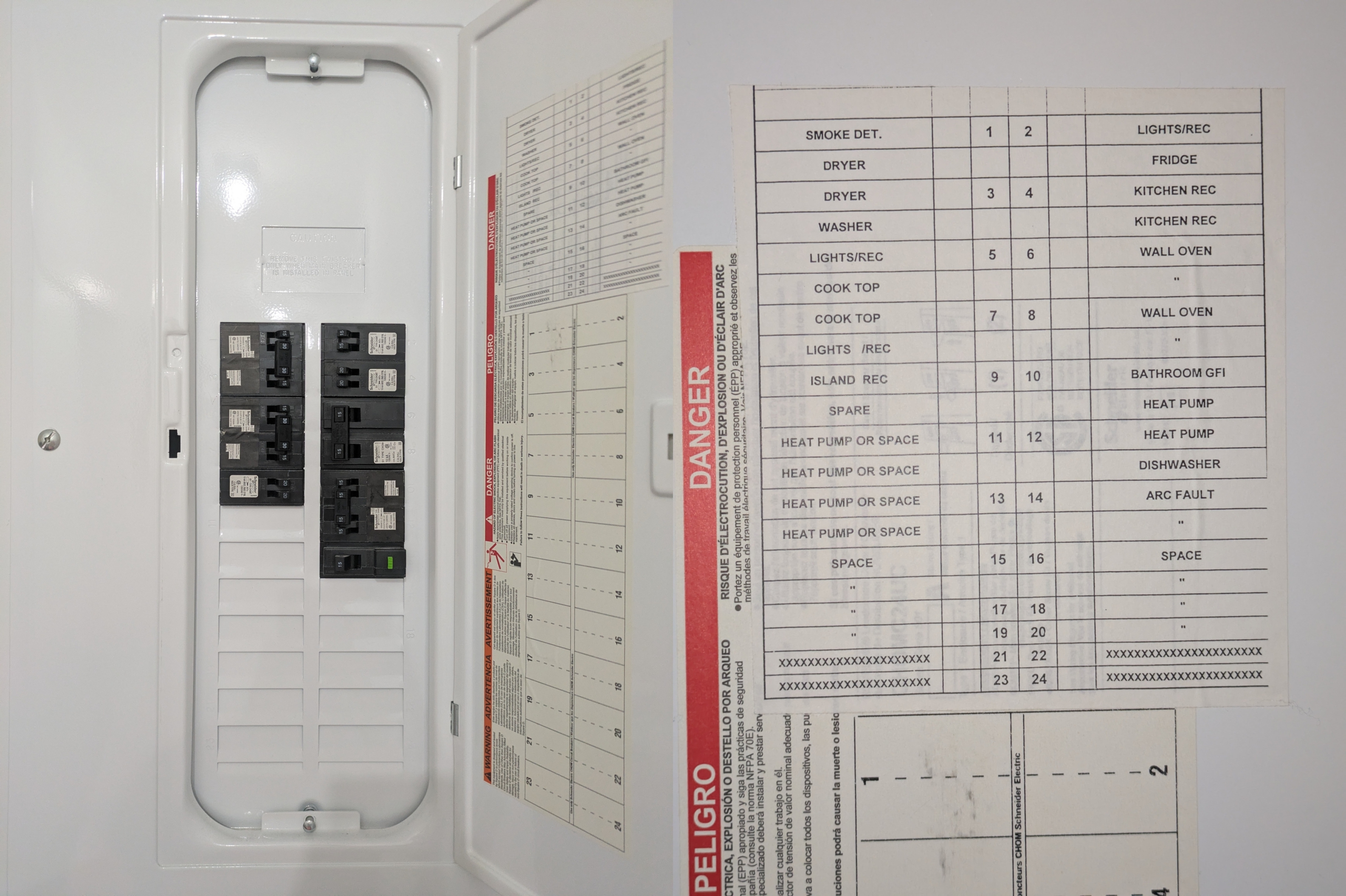
My electrical panel, left; Legend for my electrical panel, right.
Single-pole vs. double-pole breakers
One thing that I found interesting was that not all breakers looked the same. Some were bigger and spanned across multiple slots. A double-pole breaker allows the appliance to safely draw up to double the amount of power that a single-pole breaker of the same amperage would allow.
The power drawn, in watts, is equal to the voltage multiplied by the current, in amps.
$$\text{Power\ (Watts)} = \text{Voltage\ (Volts)} \times \text{Current \ (Amps)}$$
The voltage available is 120V in each slot, so, depending on the number of poles for the breaker—single-pole vs. double-pole—this changes the voltage variable, which impacts the total wattage.
So, if I look at most of the breakers in the panel, like for lights, the fridge, and most receptacles, they’re 15-amp single-pole breakers. These would draw power as follows:
$$\text{Power\ (Watts)} = \mathbf{120}\text{ V} \times 15\text{ A} = 1,800\text{ W}$$
And the double-pole 15-amp breakers, like for the wall oven, allow drawing twice as much:
$$\text{Power\ (Watts)} = \mathbf{240}\text{ V} \times 15\text{ A} = 3,600\text{ W}$$
This allows the following appliances to draw more power safely:
- Cooktop, which is on a double-pole 30-amp circuit
- Wall oven, which is on a double-pole 15-amp circuit
- Laundry dryer, which is on a double-pole 30-amp circuit
- Heat pump (HVAC), which is on a double-pole 15-amp circuit
If I take a look at my legend, it says “Heat pump or space” in slots 11, 13, and 15. In my case, it’s a space. It looks like they may have printed out a common legend for all units and some units have heat pumps in those spaces.
Arc-fault breaker
There’s also a breaker called the Arc-Fault Circuit Interrupter (AFCI). That’s the final green one at the bottom right.
Arcing is when electricity jumps from two conductors in the air. In welding, that’s desirable, whereas in your home, probably much less.
To first understand what an Arc-Fault Circuit Interrupter does for us, it’s probably a good idea to understand what an arc-fault is:
An arc fault is an unintended arc created by current flowing through an unplanned path. Arcing creates high intensity heating at the point of the arc resulting in burning particles that may easily ignite surrounding material, such as wood framing or insulation. The temperatures of these arcs can exceed 10,000 degrees Fahrenheit.
AFCISafety.org
An AFCI monitors normal and dangerous arcing conditions. It’s designed to trip in dangerous scenarios. I plan on learning more about arc faults in the future, so look out for a related blog post about that later!
In conclusion
Wow, that’s a lot of information! Let’s do a quick review:
- I have an electrical panel and it’s white
- My electrical panel has an arc-fault circuit interrupter (AFCI) in it and several circuit breakers
- Most of the breakers are single-pole breakers, while some of them are double-pole breakers, which changes the voltage delivered to the appliance
- Each circuit is either 15-amp, 20-amp, or 30-amp, where:
- most lights and most receptacles are 15-amp
- kitchen receptacles are 20-amp
- power-hungry appliances like my cooktop and laundry dryer are 30-amp
- Residential electrical panels used to use fuses, a single-use consumable, that once blown, needs to be replaced
- D/C-powered devices like handheld electronics and cars still use fuses today
In short, I really enjoyed the exercise of learning about my electrical panel, circuit breakers, and fuses! I still have a lot to learn, and I probably explained some things incorrectly, so if you know of a better way to explain things, let me know!